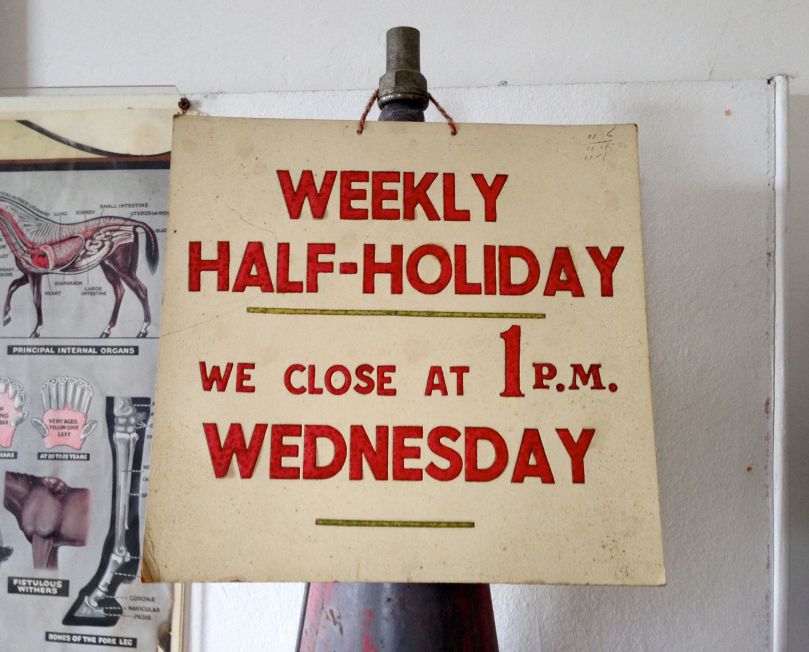
Typically, on a Wednesday, the half-day closing was not just a tradition, but was in fact required by law, and regulated by the local council.
The Shop Hours Act 1904 had already given local councils the power to require a single half-day closing, but only when two-thirds of the local retailers agreed to the proposal.
As a result, although a lot of shops were now somewhat haphazardly closing for half a day, the Shops Act 1912 came into force in May of that year, and for the first time, shop staff were entitled to a half-day off work, bringing their average working week down to 5½ days.
Although the local authority could impose the half-day on its area, generally the stores clubbed together to ensure that all of them closed on the same day — in order to preserve their businesses from competition.
What was seen as a move for the benefit of the shop staff was more probably designed to help shoppers be sure when shops would be closed. Not all shops had to close though – and exemptions applied to those that sold perishable food, medicines or newspapers. And curiously, aircraft supplies.
Each council could also set its own exemptions, and The Times of 3rd May noted that City of London had chosen to exempt umbrella dealers from the half-day closing act. How stereotypical can you get!
The act was modified a few times, but essentially remained in force until repealed in 1994.
The 1912 Act also imposed restrictions on when shops could close late, and it would seem that for many shops, closing at 7pm was commonplace, with a late closing at 8pm one day per week.
I have struggled to find out when the tradition of retail stores closing at 5:30pm, in line with many offices became commonplace, although a 6pm closing time certainly came into effect during WW2 and politicians seem to have struggled to overturn that.
Although repealed as a law in 1994, shops in smaller towns have still continued with the practice of closing for half a day per week, in defiance of modern trends towards ever longer working hours.

 Victory Marine Lodge 6160